

Restorative Dentistry
Implant Supported Dentures in Los Angeles
It stays where you put it — and the jaw keeps its bone.
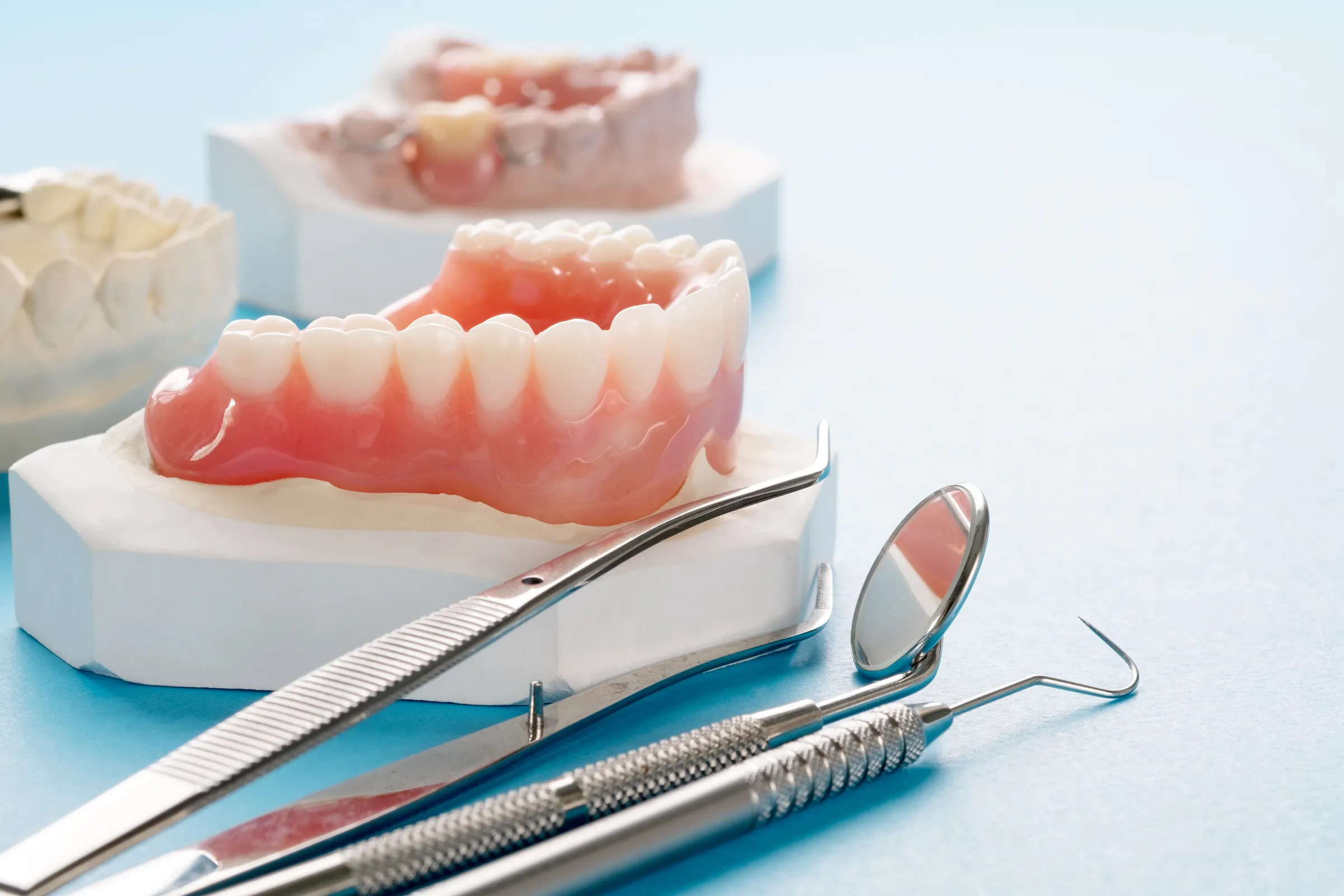
Conventional dentures need daily adhesive and periodic adjustment. Anchored to implants, a denture stays firmly in place and you can chew with the confidence of natural teeth. Smile LA Downtown Modern Dentistry recommends stabilization wherever it is appropriate, and not only for the feel of it.
Not just comfort
The reason it is not just about comfort
An unstabilized denture allows bone loss. The bone loss then makes dentures increasingly hard to wear, causes jaw problems, and eventually changes facial appearance — the sunken look people associate with dentures, which is not caused by the dentures so much as by what is happening underneath them. Implants pass load into the jaw the way tooth roots do, and that load is the signal that keeps the bone maintaining itself. So the case for stabilizing is structural before it is anything else. The comfort is real and it is what people notice, but the reason we raise it early is that the ridge you have today is the one the options depend on, and it does not wait.
Day to day
What changes day to day
- No adhesive The denture is held by the implants rather than by suction and paste.
- Chewing Firmly in place, so you can eat with confidence rather than around the denture.
- Speech Nothing shifting mid-sentence.
- Fewer adjustments Because the ridge underneath is not disappearing at the same rate.
How many implants
That depends on the arch, the bone and the design. A small number of implants can carry a full arch — see All-on-4 and All-on-6 for the fixed versions of the same idea. Where a fixed bridge rather than a denture is wanted, see implant supported bridges.
If the bone has already gone
It is often still possible. A bone graft restores structure lost to resorption or periodontitis, and in the upper back jaw a sinus lift creates the height an implant needs. The 3D scan is what tells us which applies.
The short answer
An implant supported denture is a denture anchored to dental implants placed in the jaw, rather than one held against the gums by suction and adhesive. The implants pass chewing load into the jaw the way tooth roots do, and the number needed depends on the arch, the bone and the design, which a 3D scan settles. The denture stays firmly in place for chewing and speech, needs no adhesive, and helps prevent the bone loss that makes an unstabilized denture increasingly hard to wear.
Implant Supported Dentures FAQ
- Do I still need adhesive?
- No, an implant supported denture does not need adhesive. It is held by the implants rather than by suction and paste. Because it stays firmly in place, it does not shift while you eat or speak. That also means fewer adjustments over time than a conventional denture usually needs.
- Why does it prevent bone loss?
- Implants prevent bone loss because they transmit chewing load into the jaw much as tooth roots do, and that load is the signal that keeps the bone maintaining itself. An unstabilized denture does not pass load into the bone, which is why the ridge underneath shrinks. That shrinking makes dentures increasingly hard to wear, causes jaw problems and eventually changes facial appearance. This is why the case for stabilizing a denture is structural before it is about comfort.
- Can I eat normally?
- An implant supported denture stays firmly in place, which allows you to chew with the confidence you would have with healthy natural teeth. Because it is held by the implants rather than by suction, you can eat with the denture instead of around it. Nothing shifts mid-sentence either, so speech is steadier as well. How the denture is designed for your arch is worked out at the planning stage.
- How many implants will I need?
- The number of implants depends on the arch, the bone and the design, and a small number can carry a full arch. A 3D scan shows how much bone there is and where, which settles the number for your case. All-on-4 and All-on-6 are the fixed versions of the same idea. Where a fixed bridge rather than a denture is wanted, implant supported bridges are the option to compare.
- What if I have already lost bone?
- Implants are often still possible after bone loss, because a bone graft, or a sinus lift in the upper back jaw, may restore what is needed. A bone graft rebuilds structure lost to resorption or periodontitis. A sinus lift creates the height an implant needs in the upper back jaw. Which of these applies, if any, is assessed from the 3D scan.