


Periodontal Care
Gum Disease Treatment in Downtown Los Angeles
Stopping it where it is, and keeping the teeth it threatens.
Gum disease is progressive, and how much can be undone depends entirely on when it is caught. The team at Smile LA Downtown Modern Dentistry treats every stage of it, from the reversible beginning through to the point where bone is involved.
The progression
The three stages
Gum disease is progressive, and the single most useful thing to know about it is that only the first stage can be undone. Everything after that is manageable rather than reversible, which is why the point at which it is caught matters more than almost anything else about it. The difficulty is that it is quiet. It rarely hurts, the early signs are easy to explain away as brushing too hard, and it can go a long way without ever feeling like a problem — which is how a condition that starts as bleeding gums ends as bone loss. The three stages below describe the same disease at three points along that line, and the treatment for each is a different proposition.
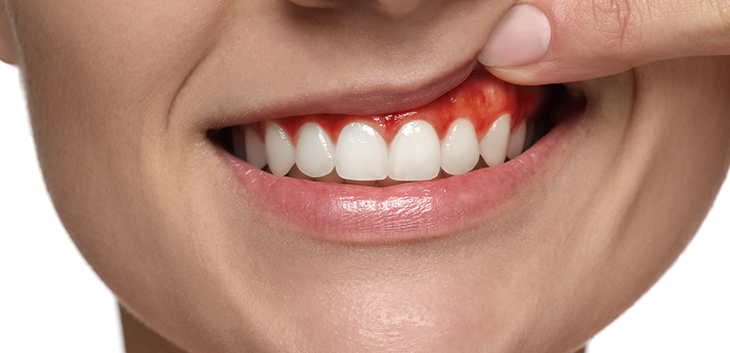
- Gingivitis The earliest stage, and the only one that is reversible. Early signs are swollen, tender gums, bleeding when you brush or floss, and sensitive gum tissue. It is often called the silent disease because it can go unnoticed until it has progressed — which is exactly why early detection matters.
- Periodontitis More advanced. Treatable, but not reversible. As plaque builds it forms pockets under the gum line, and those have to be professionally cleaned to remove the debris and bacteria. Regular cleanings and proper care at home prevent further damage from here.
- Advanced periodontitis Now affecting the bone that supports your teeth, and capable of causing tooth loss if left. Our methods aim to preserve affected teeth wherever possible, which makes timely intervention the whole game.
The treatments
The treatments we offer
- Deep cleanings For periodontitis: removing debris and bacteria from the hard-to-reach areas between gums and teeth, eliminating infection and reducing pocket depths so the disease stops progressing.
- Gingivoplasty Reshaping the gum tissue to improve both function and appearance. Soft tissue re-contouring that makes the gum line look right as well as work properly.
- Flap surgery Where pockets are deep. Lifting the gum tissue gives access to clean the underlying structures thoroughly and re-contour the gums, reducing pocket depths.
- Bone grafting Restoring bone structure lost to periodontitis, rebuilding the jawbone to support the remaining teeth and give a solid foundation for future restorations.
- Crown lengthening Adjusting the gum line to expose more natural tooth. Often necessary before restorative work, so a crown fits properly and the final result looks right.
- Dental implant placement Where teeth have already been lost. Implants placed securely in the jawbone give a restoration that matches natural teeth in both function and appearance. See dental implants.
Who treats it
Dr. Kourosh Yousefzadeh and Dr. Razmik Galustian lead the periodontal care here, with extensive experience and a habit of staying current with what has changed. Treatment is tailored to the individual mouth rather than run off a protocol.
When gum surgery is needed
Gum surgery is often needed when non-surgical treatments like scaling and root planing are not enough to treat advanced gum disease. It can treat gum disease, repair gum recession or improve the appearance of your gums. Common types include gum grafting, pocket reduction surgery and crown lengthening. Treating gum disease with surgery can help stabilize teeth and prevent tooth loss.
Before, during and after
- Preparing Your dentist will give you specific instructions, which may include stopping certain medications and arranging for someone to drive you home.
- During the procedure It is performed under local anesthesia. Some discomfort afterward is normal and can be managed with pain relievers.
- Recovery Recovery time varies, but most people can return to normal activities within a few days to a week.
- Aftercare Follow your dentist’s aftercare instructions, which typically include avoiding certain foods, using a special mouthwash and taking prescribed medications.
- Risks Risks may include infection, bleeding or discomfort, and your dentist will discuss these with you before the procedure.
Prevention, and the periodontist’s role
Maintaining good oral hygiene and regular dental visits can help prevent gum disease and the need for surgery. A periodontist specializes in treating gum disease and performing gum surgery, while a general dentist provides a broad range of dental care.

The short answer
Gum disease is a progressive infection of the gums and the bone that supports the teeth, and it develops in three stages: gingivitis, periodontitis and advanced periodontitis. Only gingivitis is reversible; periodontitis is treatable but not reversible, and advanced periodontitis affects the supporting bone and can lead to tooth loss. Treatment depends on the stage and ranges from deep cleanings to flap surgery, bone grafting and crown lengthening.
Gum Disease FAQ
- Can gum disease be reversed?
- Only gingivitis, the earliest stage, can be reversed. Periodontitis is treatable but not reversible, and from that point the disease is managed rather than undone. That is why the point at which it is caught matters more than almost anything else about it.
- How would I know I have it?
- Early signs are swollen, tender gums, bleeding when you brush or floss, and sensitive gum tissue. It is often called the silent disease because it rarely hurts and can go unnoticed until it has progressed. The early signs are easy to explain away as brushing too hard, so a screening at every checkup is the reliable way to find it.
- What is a deep cleaning?
- A deep cleaning removes debris and bacteria from the hard-to-reach areas between the gums and teeth. It is the treatment for periodontitis, where plaque has formed pockets under the gum line that have to be professionally cleaned. Clearing them eliminates infection and reduces pocket depths, which stops the disease progressing further. Regular cleanings and proper care at home then help prevent further damage.
- Will I lose teeth?
- Advanced periodontitis affects the bone that supports your teeth and can result in tooth loss if left untreated. Treatment aims to preserve affected teeth wherever possible, and timely intervention is what makes that achievable. Where teeth have already been lost, dental implants placed in the jawbone can restore them.
- What is flap surgery for?
- Flap surgery is used where periodontal pockets are deep. Lifting the gum tissue gives access to clean the underlying structures thoroughly and re-contour the gums. That re-contouring is what reduces the depth of the pockets.
- Can lost bone be rebuilt?
- Bone lost to periodontitis can be restored with bone grafting. Grafting rebuilds the jawbone to support the remaining teeth and to provide a solid foundation for any future restorations. It is one of the treatments for gum disease that has reached the bone, alongside flap surgery.